
Cheshire East councillors decide on 14 October whether to object to or support the Peak Cluster CO2 pipeline, routed past Higher Poynton, Disley and Gawsworth.
Cheshire East councillors will decide on Wednesday 14 October whether the council should object to or support the Peak Cluster carbon dioxide pipeline.
Until now the council has not taken a position on the scheme. The question goes to full council at 11am, at the Tenants’ Hall in Tatton Park. (council summons)
What councillors are being asked
An officers’ report, published on Wednesday, recommends that full council:
- notes the latest information on the scheme
- considers a notice of motion, then decides whether it wishes to object to or support the pipeline
- decides what further action to take and what to say to the government about the principle of the pipeline
The wording of that motion was not published with the report. Officers say it is being agreed between the councillors proposing and seconding it, and is meant to be circulated before the meeting. (officers’ report)
Whatever the vote, the council does not decide the scheme. Peak Cluster is a nationally significant infrastructure project, so the Secretary of State grants or refuses it. Cheshire East’s formal role starts when the application is submitted. It will then write a Local Impact Report and make representations to the Planning Inspectorate.
How it got here
On 15 July, Councillor Lesley Smetham, seconded by Councillor Hayley Whitaker, put a motion to full council. It objected that the council’s Corporate Policy Committee had, on 30 April, kept the decision on the council’s position away from full council. It asked that the position be decided by all councillors at this meeting. (July notices of motion)
The July motion said the route passes through 22 of the borough’s towns and parishes. It also said Cheshire West and Chester, Derbyshire County Council and Wirral Council had already formally declared their opposition. It listed concerns from five parish councils on our side of the borough and further south, including:
- Prestbury Parish Council, which objects, citing the loss of ancient woodland and farmland
- Gawsworth Parish Council, worried about safety data, the Danes Moss SSSI, and a proposed above ground installation
- North Rode Parish Council, asking how the pipeline would cross the River Dane, and about narrow lanes and footpaths during construction
What the officers’ report says about our area
Peak Cluster’s first public consultation ran from 12 January to 27 February 2026. The report sets out how the route changed when the company narrowed its corridor from 300 metres to 100 metres on 21 September. On the Macclesfield side:
- Higher Poynton and Disley: the northern of the two earlier route options has been confirmed
- Gawsworth and Marton: the southern pipeline now turns north-west towards Marton, about five miles south-west of Macclesfield, before it reaches Gawsworth. Officers say that reduces the impact on Gawsworth and moves the pipeline away from the Danes Moss SSSI, although it is still inside that site’s consultation zone
- Lyme Park: officers say this is the only place the route appears to cross peatland, but that, cross-checked against national mapping, it appears to avoid the peat within the park
Officers expect two above ground installations in Cheshire East. Their locations have not been published. The report says where they go, how big they are, and how they are reached and secured “remain key issues of objection and concerns” from residents, councillors and parish councils.
Safety: what the council’s public health team says
The council’s public health team says a major CO2 pipeline rupture could harm people nearby. It cites a 2020 incident in Satartia, Mississippi, where engines failed in the oxygen-poor air, making it hard for emergency responders.
It also says significant uncertainties remain about how large releases behave, especially in complex terrain, and that a national research programme, Project Skylark, is investigating the gaps. Until that evidence and final engineering details exist, the team says a robust assessment of the health risk is not possible. It recommends that Peak Cluster carry out a dedicated Health Impact Assessment.
The report quotes Peak Cluster’s own position: that the design meets UK standards and keeps risks to levels accepted by the Health and Safety Executive and the Environment Agency.
What happens next
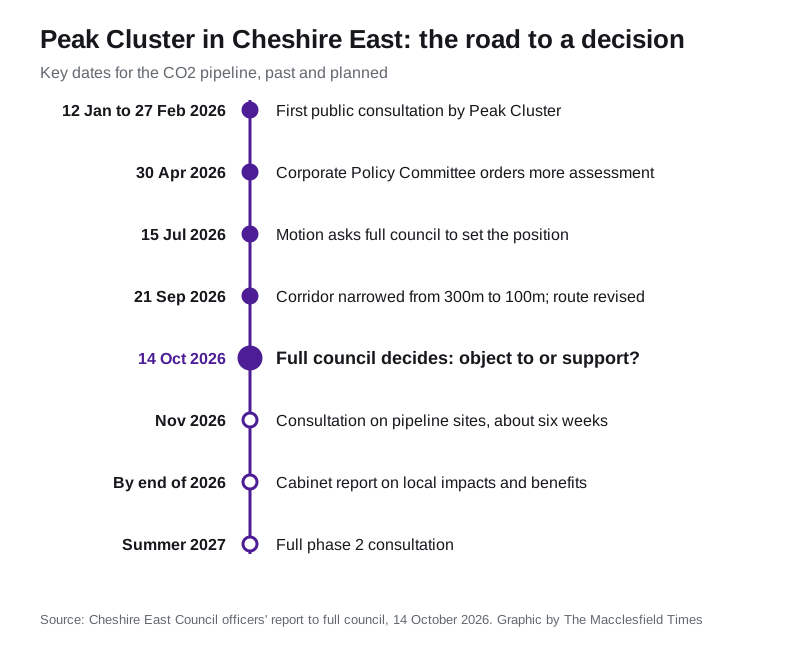
According to the report:
- November 2026: Peak Cluster opens a consultation, expected to last about six weeks, on where the pipeline’s above ground installations, block valve stations, construction areas and access routes would go
- before the end of 2026: a further report goes to the council’s Cabinet, setting out local impacts and benefits
- summer 2027: Peak Cluster’s full phase 2 consultation, with an updated boundary and its first environmental findings
Officers also plan meetings with affected town and parish councils over the next five weeks, arranged through the Cheshire Association of Local Councils.
What it means for you
The deadline to register to speak at Wednesday’s meeting passed at midnight on 8 October. The public part of the meeting is audio recorded and the recording goes on the council’s website afterwards.
The consultation that matters most for where things would be built on the ground is Peak Cluster’s own, in November. If you live near the route around Higher Poynton, Disley, Gawsworth or Marton, that is when you can comment on the locations of the above ground installations. Our earlier report on the September route change near Gawsworth has the company’s interactive map.
Have your say