
Cheshire East is raising fly-tipping penalties to £5,000 from 1 September. Its own Defra return records 42 enforcement actions last year against 3,784 fly-tips.
Cheshire East Council is raising its fines for fly-tipping and littering, with penalties of up to £5,000 available for the most serious offences from 1 September. It announced the new levels on 21 August. (Cheshire East Council media release, 21 August 2026)
The new fixed penalty notice levels are:
- Lower-tier fly-tipping: £500, reduced to £300 if paid within 14 days
- Higher-tier fly-tipping: £1,000, reduced to £600 if paid within 14 days
- The most serious fly-tipping: up to £5,000, from 1 September
- Littering: £150, reduced to £90 if paid within seven days
- Littering involving more than one item: £200, reduced to £150 if paid within seven days
The council says its previous levels “had not been reviewed for several years”. Its own return to Defra puts the old fly-tipping penalty at £400, or £200 if paid early, so the lower tier is a £100 rise and the higher tier is two and a half times the old figure.
The £5,000 ceiling is not the council’s decision. The government raised the maximum fixed penalty for fly-tipping from £1,000 to £5,000, a 400% uplift, and lifted the maximum for littering by 50% to £750, in an announcement made on 15 July. (Defra, War on waste crime, 15 July 2026) Cheshire East has taken the full fly-tipping ceiling and set its littering penalty at £150, a fifth of what it is now allowed to charge.
What the council’s own enforcement record shows
Every council in England reports its fly-tipping to Defra, including what it did about it. Cheshire East’s returns for the last three years are the context the press release does not carry.
| 2022/23 | 2023/24 | 2024/25 | |
|---|---|---|---|
| Fly-tipping incidents | 4,108 | 4,047 | 3,784 |
| Total enforcement actions | 615 | 165 | 42 |
| Investigations | 456 | 157 | 0 |
| Warning letters | 52 | 0 | 0 |
| Fixed penalties for fly-tipping | 17 | 4 | 9 |
| Vehicles seized | 49 | 0 | 0 |
| Prosecutions | 10 | 0 | 0 |
Source: Defra ENV24, fly-tipping incidents and actions taken in England, local authority tables, 2024/25 release.
In 2024/25 the council recorded 42 enforcement actions in total, and every one of them was a fixed penalty notice: 9 for fly-tipping, 10 for household duty of care, 2 for littering issued alongside a fly-tip, and 21 other penalties. It logged no investigations, no warning letters, no vehicles seized and no prosecutions at all.
Two years earlier it recorded 456 investigations, 49 vehicles seized and 10 prosecutions, which produced £810 in court fines.
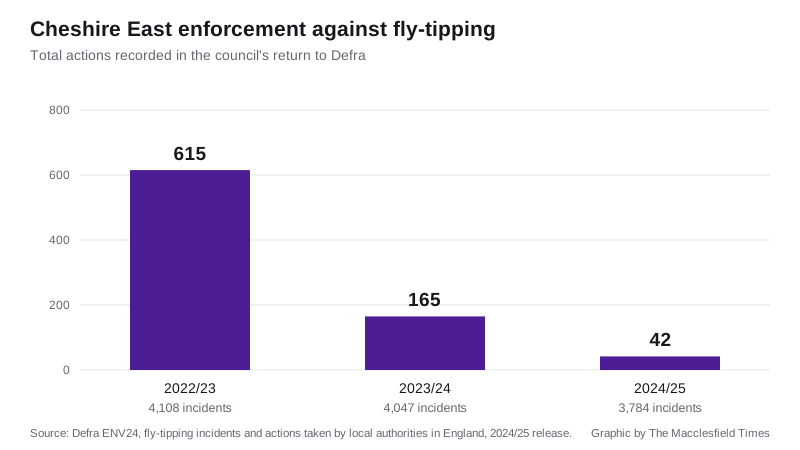
A caution on reading that. Defra warns that authorities differ in how thoroughly they log both incidents and actions, and a drop from 456 investigations to none in two years is steep enough that a change in recording practice is at least as likely an explanation as a change in activity. Every figure above is a genuine zero in the return, not a blank. The council’s release does not mention its enforcement record, and it has not published an explanation of the change.
The penalty most residents have never heard of
Ten of last year’s 42 penalties were issued for household duty of care. That is the offence the council’s release is pointing at when it asks residents to check that anyone taking waste away is licensed.
The duty falls on the householder, not just the person who dumps the load. Pay a man with a van to clear a garage, and if that waste turns up in a lay-by with your name in it, the penalty can land on you. It is the single most likely way an ordinary Macclesfield or Knutsford household ends up with a fine, and it is the reason the licence check matters more than the headline £5,000.
What actually gets dumped here, and where
Cheshire East’s 3,784 incidents in 2024/25 were not, for the most part, organised waste crime.
By where it was left:
- Highways: 1,887
- Back alleyways: 1,694
- Council land: 149
- Footpaths and bridleways: 38
By what it was:
- Other household waste: 2,156
- Household black bags: 732
- Construction, demolition and excavation waste: 214
- White goods: 166
- Green waste: 134
- Tyres: 122
By size, 1,741 were a small van load, 952 a car boot or less and 741 a single item. Eleven were a tipper lorry load and six were larger still.
In other words the borough’s problem is overwhelmingly domestic-scale rubbish dumped on roads and back entries, and only a fraction is the tipper-load fly-tipping the £5,000 penalty is designed for.
How Cheshire East compares with its neighbours
Both halves of this are worth having.
The borough has relatively little fly-tipping. At 9.0 incidents per 1,000 residents, Cheshire East was the seventh lowest of the 34 North West authorities in 2024/25. Manchester recorded 25.4 and Liverpool 39.9. The rate has fallen in each of the last two years, from 10.1 in 2022/23 to 9.8 and then 9.0.
On enforcement it sits at the other end. Its 42 total actions were the third lowest in the North West. Only Chorley and Liverpool recorded fewer, and both of those recorded none at all. Cheshire West and Chester logged 1,661 actions, Stockport 1,886, Warrington 2,672 and Trafford 4,592.
What it means for you
- From 1 September, the top tier of fly-tipping penalty in Cheshire East is up to £5,000. The lower and higher tiers of £500 and £1,000 carry a discount for payment within 14 days; the littering penalties carry a seven-day discount.
- Check the licence before anyone takes your waste. The Environment Agency runs a free public register of registered waste carriers and brokers, searchable by name or registration number, at environment.data.gov.uk. Ask for the registration number, then look it up. A quote that is much cheaper than everyone else’s is the usual warning sign.
- Ask where it is going. You are entitled to know, and to a written transfer note. Keeping that paperwork is what protects you if the waste is later found dumped.
- Report a fly-tip through the council’s street cleansing form, which also covers dumped fridges, mattresses and garden waste. The council says a witness statement is what turns a report into a prosecution, but asks people to report incidents even if they do not want to be a witness. (Cheshire East, street cleansing, litter and fly tipping)
Anyone issued with a fixed penalty notice can decline to pay it, in which case the council must decide whether to prosecute in the magistrates’ court, where the offence is dealt with under the Environmental Protection Act 1990.
Have your say